
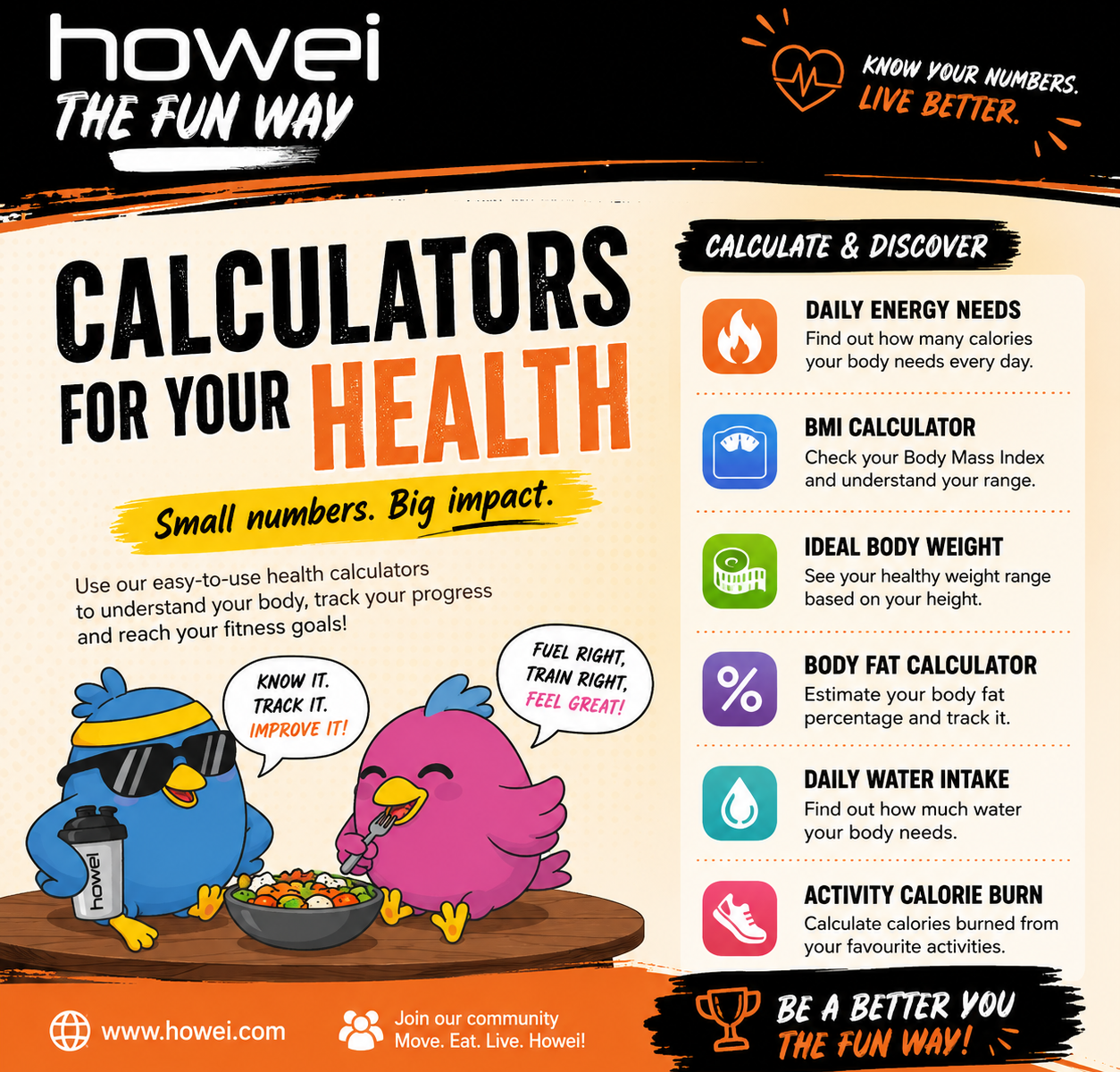
Howei’s My Fitness Program: Fuel Your Fun, Build Your Fitness!
Getting fitter isn’t about eating as little as possible or spending every waking hour in the gym.
It’s about finding the right balance between movement, food, recovery and consistency—and, most importantly, making the journey enjoyable.
That’s the idea behind Howei’s My Fitness Program: a fun way to understand your body, discover how much energy you actually need, and turn everyday activity into progress.
Because whether you’re training for a 5K, chasing a new personal best, getting ready for HYROX, or simply trying to feel better climbing the stairs… your body needs fuel! 🐦🔥
🍚 So… How Much Energy Do You Actually Need?
Think of your body as a car.
Even when your car is parked, the engine still needs fuel to keep everything running.
Your body is the same.
Even while you’re sleeping, you’re using energy to:
❤️ Keep your heart beating
🫁 Keep you breathing
🧠 Keep your brain working
🌡️ Maintain your body temperature
🔧 Repair and maintain your body
This basic energy requirement is called your Basal Metabolic Rate (BMR).
BMR can account for roughly 45–70% of daily energy expenditure, while physical activity is one of the biggest variables affecting how much energy you need.
Then you add everything else you do during the day:
🚶 Walking
🏃 Running
🏋️ Training
🚴 Cycling
🧹 Housework
💼 Working
🛒 Shopping
🎮 Even moving around between activities!
Together, these contribute to your total daily energy needs.
⚡ Your Energy Equation
A simple way to think about it is:
Energy Needed = Basic Body Needs + Daily Activity + Exercise + Digestion
And here’s the fun part:
The more active you are, the more fuel your body may need.
Australian dietary guidance recognises that energy requirements vary according to factors such as age, sex, body size and physical activity level.
So there isn’t one magic number that everyone should eat.
Your body isn’t a photocopier.
It’s uniquely YOU. 😎
🐦 Meet the Howei Mascots Hoho & Weiwei
Imagine our Howei birds after a workout.

Hoho, the blue bird has just finished lifting weights.
Weiwei, the fuchsia bird has completed a hard cardio session.
They’re hungry.
VERY hungry.
But instead of thinking:
“I exercised, so I can eat anything!”
they think:
“I exercised, so let’s give our bodies the good stuff they need to recover!” 🍳🥦🍚
That’s the spirit of My Fitness Program.
Fitness isn’t about punishment.
Exercise isn’t something you do to earn food.
Food is fuel.
Movement is fun.
Recovery is important.
And consistency is king. 👑
🧮 Let’s Calculate Your Energy Needs
A fitness programme becomes much more useful when you understand your approximate daily energy requirements.
A basic approach starts by estimating your BMR, then considering your physical activity level.
For adults, energy requirements can be estimated using BMR multiplied by a Physical Activity Level (PAL). Australia’s Eat for Health resources use PAL values ranging from around 1.2 for very sedentary activity to 2.2 for vigorous activity.
So, conceptually:
Estimated Daily Energy Requirement ≈ BMR × Activity Level
For example, imagine someone has an estimated BMR of:
1,600 kcal/day
If their overall activity level is approximately 1.5:
1,600 × 1.5 = 2,400 kcal/day
That’s an estimate, not a prescription.
Real energy requirements vary considerably between individuals, and estimates can be less accurate for an individual than for a population.
That’s why Howei’s approach is about understanding your numbers—not obsessing over them.
🔥 Training Day ≠ Rest Day
Here’s another reason energy awareness can be useful.
You might have:
🛋️ Rest Day
Little structured exercise.
🚶 Active Day
Lots of walking and daily movement.
🏃 Training Day
Running, strength training, cycling or sports.
🐲 BIG TRAINING DAY
Long run + strength workout + lots of movement.
Your energy needs can change from day to day. Australia’s Eat for Health guidance specifically notes that energy requirements can vary with physical activity and from one day to another.
So don’t panic because your activity tracker says you had a “big calorie day.”
Maybe…
YOU HAD A BIG DAY! 😂
🥦 Fuel Your Fitness, Don’t Just Count It
Calories—or kilojoules—are only part of the story.
The Australian Dietary Guidelines encourage people to choose nutritious foods in amounts that meet their energy needs, while eating a wide variety of foods from the five major food groups.
Think:
🥦 Vegetables & legumes
🍎 Fruit
🌾 Wholegrain & high-fibre grains
🥚 Lean meats, fish, eggs, tofu, nuts & legumes
🥛 Milk, yoghurt, cheese & alternatives
Your goal isn’t simply:
“How few calories can I eat?”
It’s:
“How can I give my body the energy and nutrients it needs to move, perform and recover?”
That’s a much better question.
🏃 Your Fitness Journey Starts With One Step
Maybe your goal is:
5 KM → 10 KM → Half Marathon → Full Marathon
Or perhaps:
Walk more → Get stronger → Run your first 5K → Improve your fitness
Or maybe your goal is simply:
“I want to feel better and have more energy.”
That’s a perfectly good goal too.
Fitness doesn’t have to look the same for everyone.
The important thing is to start somewhere, measure your progress and keep moving.
🎯 The Howei Challenge
Here’s your My Fitness Program challenge:
1️⃣ Know your number
Estimate your daily energy needs.
2️⃣ Know your movement
How active are you really?
3️⃣ Move more
Walk, run, cycle, lift, stretch, play!
4️⃣ Fuel better
Choose nutritious foods that support your activity.
5️⃣ Recover
Sleep, rest and give your body time to adapt.
6️⃣ Have FUN!
Because if fitness feels like punishment…
you’re probably doing it the boring way. 😜
🐦 The Howei Way
At Howei, we believe fitness should be social, measurable and FUN.
Whether you’re chasing a medal, completing your first run, joining a community workout or simply trying to become a healthier version of yourself, every little step counts.
So grab your water bottle.
Put on your shoes.
Eat something that fuels you.
And get moving.
Calculate your energy.
Challenge your fitness.
Celebrate your progress.
Become a fitter YOU—the fun way. 🧡
Note: Energy calculations are estimates for generally healthy individuals and aren’t a substitute for personalised advice from a dietitian, doctor or other qualified health professional, particularly if you have a medical condition or specific nutritional needs. The Australian Dietary Guidelines likewise note that they do not apply to people who need special dietary advice for a medical condition.